Tag Archives: Employee Benefits

What Zenefits Tells Us about the Benefits Market


Maybe I should stop writing about Zenefits but Zenefits is not going to go away. Last weekend I was at a youth basketball game and I ran into a broker I knew who told me their firm lost a 110 person client to Zenefits. This was a Massachusetts broker. This weekend I got an email from a broker in Pennsylvania who needs help because they just lost a 75 person firm to Zenefits. I am sure with Zeneifts generating in excess of a million dollars in commissions a month these stories are a frequent event. While many brokers may think Zenefits is a fad I think Zenefits says a lot about the benefits business that few brokers are recognizing. If you want to learn a little about the Zenefits model you can read my other blog titled, “If You Want to Be like Zenefits You have to mow the Lawn”. https://joemarkland.wordpress.com/2014/10/15/if-you-want-results-like-zenefits-you-need-to-mow-the-lawn/.

I speak at many broker conferences and I often ask brokers how they are different. The most common answer I get is that they provide great service and have strong relationships. It is in this environment that Zenefits comes in and displaces more broker’s business faster than any company has ever done. And they do this with a different value proposition, extensive marketing, and no local service. So while most brokers think their service is a differentiator and of great value there are a large number of employers that don’t put the same value on the service. I think these employers are buying into Zenefits for one of two reasons:

  1. They think they have some new and great technology.
  2. They are looking for help administering their HR and Benefits and they see Zenefits as a firm that is offering this help.

Based on my experience the Zenefits technology and service offering on average has a street value of around $5-$10 per employee per month. This cost would vary based on the client size. They are displacing brokers that receive commissions of $20-$40 per employee per month for providing brokerage services. What this tells us is that the employer market values the Zenefits $5-$10 offering more than the brokers $20-$40 PEPM services. They may not know the street value of what Zenefits is delivering or know what their broker is getting compensated but is doesn’t matter. One is being sold against the other.

Many brokers have acknowledged that they believe they are highly compensated. For that reason they have been adding free “value-added” services to employers so that they can “give back” something. These value added services have ranged from benefits enrollment systems and HR call centers to wellness programs. The major difference between the average broker’s value-added services and what Zenefits is delivering is that Zenefits appears to be offering something that is in greater demand.

As a consultant in the HR and Benefits technology space I believe this demand will stay strong until the majority of employers have automated their HR and Benefits. This will be for years to come. So while many brokers can hope that Zenefits will go away I believe the demand for what they are delivering will grow. And there will be others. The Zenefits model tells us the benefits market is changing. What employers have valued in the past may be of less value in the future.

Why the Utah Department of Insurance is Wrong About Zenefits


Some of you may have seen that the Utah Department of Insurance has issued a letter demanding that the new California based benefits broker/technology Company named Zenefits cease conducting their business as is or they will face major fines and need to return their commissions earned in Utah. Zenefits is providing a free HR/Benefits system in exchange for naming them the benefits broker. Zenefits claims they give their system away to any firm and don’t require the benefits business, but let’s stop pretending, we all know that nothing is free. To the best of my knowledge 100% of their revenue is from receiving commissions as a benefits broker. The State of Utah says that Zenefits is engaging in rebating through this practice. I believe the State of Utah is wrong but also believe the other interested parties are somewhat disingenuous with their arguments including those supporting Zenefits and those supporting the State.

Let’s start with the rebating issue. I am not going to get too technical with the legal ease. The Utah Insurance laws allow the free distribution of a benefits enrollment system but not a HR System. Their language is as follows:

According to R594-154-11. Electronic Platform and Application Systems – Producers or agencies may provide electronic platforms that provide directly related services of the insurance products to the employees. Fair market value must be charged for items such as human resources and legal services whether electronic or paper.

The State is saying Zenefits is giving away a HR system. They also add some other things to their letter to Zenefits such as it is illegal to require an upload of data before the purchase of benefits and the way Zenefits advertises is illegal, but it is all related to the HR system. Zenefits can be back in business and avoid fines if they charge fair market value for the system. The main issue is the free HR system. In my opinion all other claims are secondary.

Here is why the State of Utah is wrong. Benefits enrollment systems, HR systems, and Payroll systems are becoming one system. At my company, HR Technology Advisors, we recently conducted a national survey that found that over 80% of the employer market is looking for a single technology platform that manages HR and Benefits and sometimes Payroll in a single system. Zenefits and almost all the leading HR and Payroll vendors including ADP, Paychex, Ultimate Software, Workday, Oracle, and many more are responding to this market demand by delivering these more robust platforms. When they sell their systems many don’t draw the lines between HR and Benefits the way the State of Utah has. They are different parts of the same body. If I buy the system I get the HR and benefits parts whether I use them or not. One of the leading systems I know charges $5 PEPM for their system. Without the HR it is $5. With the HR it is $5. The Utah Insurance laws treat these systems like they are different systems when they are not. The vendors don’t make a distinction. In fact some brokers give away Private Exchange technology that cost $6 PEPM when some HR systems with benefits enrollment systems costs $5 or less. This is why the State of Utah is wrong. They are assuming these systems come in pieces and that a fair market value for the HR part can be pieced out. The world has changed and the Utah State laws have not.

Think of this for a minute. If the market is moving to single systems for HR and benefits then many of the benefit system provider will need to add HR functionality to compete with Zenefits and others. What happens if you are a broker providing a free benefits enrollment system within Utah law and the vendor adds some HR functions in their next product release? They do this with an update on a weekend overnight. Do you have to send a bill to all your Utah customers for the fair market value? What if the vendor does not charge for this new feature? Is there a fair market value? Also, how many brokers give away HR Libraries, HR Call Centers or Compliance Alerts, that aren’t just benefits? I looked at the websites of other benefits firms in Utah and they promote other HR type systems. Zenefits is definitely more open about what they are giving away but I guarantee they aren’t the only benefits firm that may in some way be breaking the Utah rebating laws as currently defined.

Here is another reason why the State of Utah is wrong. Rebating laws would imply that the buyers are making their purchase decision based on the free offering. I don’t think the Zenefits buyers are choosing Zenefits because of a free $5 PEPM HR system. They aren’t attracted to the incentive/rebate as the State implies. They are buying Zenefits because Zenefits is promising to make their HR/Benefits lives easier. You don’t get 2000 new clients in two years because of a free $5 PEPM system. You get 2000 new clients because you are solving a big problem. If in fact Zenefits is getting the business because of a free $5 PEPM system then that doesn’t say much for the value of a benefits broker. It would imply the benefits broker is highly over-compensated which should then be a bigger issue for the State Insurance Department.

Let’s also not pretend what Zenefits is and isn’t. I saw one article with the title, “Utah Gov. Herbert: Don’t Shut Down Zenefits; Stand Up for Innovation and Online Competition”. To me Zenefits is neither real innovation nor online competition. For the most part they are a benefits broker using a large marketing budget to do what others are already doing. Their technology is not unique as there are many vendors that do the same thing. In fairness to Zenefits they aren’t claiming to have invented something new. They are saying that they are helping employers with a problem by leveraging technology. Any broker can do this in 48 hours if they wanted to. In my opinion what Zenefits really is is a disruptive business model. Is Uber a great technology or a disruptive business model? How about Orbitz and Amazon? Many brokers have a business model similar to Zenefits. What most brokers don’t have is the $66 million to market this model across the country and disrupt the market as Zenefits is doing.

So the State of Utah should understand that benefits enrollment systems and HR systems are one system. They are two arms on the same body and can’t be disconnected. They need to get with the times. Benefits brokers also need to adapt and stop filing complaints against Zenefits with the State Insurance Bureaus. Many are delivering HR things for free already and they can deliver a Zenefits-like model but it takes work. And Zenefits should almost stop pretending they aren’t a benefits broker. Sure they have a nice technology and they have a lot of money to disrupt the benefits distribution channel. But they are what they are. They are knowingly giving away technology in exchange for benefits commission. That’s OK because they are helping employers by solving problems. All parties are somewhat twisting the story but in my opinion this is just noise created when change happens.

One final thought. If benefits commission is so lucrative that it can fund the development of HR software that many companies often spend tens of millions of dollars to build, then don’t expect the rest of the world sit on the sidelines. Paychex is already a broker. Will other firms that compete with the Zenefits technology jump into the benefits brokerage business? How does a HR technology vendor compete with free? They have to access the revenue source that funds free. The world will change. Let the games begin.

The Coming End to the Health Insurance Business as We Know It – And What Brokers Can Do About It


I want to start by saying that I am knowingly writing an article that is going to throw fuel on a fire. Being from New England this would be like writing an article in the Denver Post that says Brady is better than Manning. Letters will be written. Darts will be thrown. I know it so I will make sure I put on my steel vest before I publish. In fact I already started writing on this topic in a recent article titled, “Apple HealthKit – The Next Step to the End of Employer Based Health Insurance” that generated an emotional response from many. In this article I will provide a more detailed analysis of why the premise presented in my first article may come true. My core belief is that within 5-10 years employers will be out of the health risk business. I will then provide a plan for what I think benefit brokers should do to prepare for this possible change in the market. Taking action may be the difference between those that survive and thrive in this new health insurance world versus those that may struggle or even fail.

What do I mean when I say employers will be out of the health risk business? To repeat what I said in my last article, “by health risk I mean the cost of the employee’s health insurance will not be priced by employer. It won’t be a function of average age of the employee population, claims experience, or any of the standard underwriting/pricing rules today.” In fact, health insurance will most likely become an individually purchased product and the insurers of the future may not be the companies that dominate the market today. The players and the structure of the market will be vastly different.

As a consultant to benefits brokers, I educate them on technology and advise them on how they can maintain a competitive position. My own future is dependent upon brokers remaining significant so I am as concerned about their future as any broker would be. So for my own benefit and the benefit of my customers I am constantly “taking the pulse of the market” so that I can make the right business decisions. I do this by watching what I call “significant market moves”. Such a move is a company making an acquisition for $200 million, whereas a press release or one-sided market study I simply consider noise. Companies don’t make acquisitions for hundreds of millions of dollars because it would be a nice thing to do. Press releases are easy. If you study the significant market events over the past few years it begins to paint a picture of what the future may be like. While many may think ObamaCare is the big market change I believe that the story goes well beyond healthcare reform. The health insurance market is going to change much more dramatically and while the government may be nudging things along it will be competitive market forces that will be responsible for the change.

So let’s get to the point. I believe that within 5-10 years health insurance will be delivered primarily through staff model HMO’s. These will be Kaiser-like plans where the providers of care will also be the risk takers/insurers. Individuals will pay a fee directly to a healthcare system that will be responsible for the health, wellness, and treatment of the person. Employers may still give employees money to pay for some of the cost but they won’t be in the “risk” business. We are beginning to see this evolution today through the expansion of what people are calling Accountable Care Organizations (ACOs). However, the future will go well beyond the limited risk sharing of today’s ACOs.

Four Catalysts to Change

If you had been in the health insurance business in the 80s you would say we tried this before and it didn’t work. Well today things are different. There are 4 major differences between now and then that will be the catalysts for the coming changes. They are as follows:

Change in Consumer Buying behavior

In the 80s, employers often paid for 100% of an employee’s health insurance and a large part of the family. When cost wasn’t an issue for employees they looked at provider access as the number one variable. So all the HMOs and PPOs tried to expand their networks to appease more people. Today cost is the number one issue. As a result we are seeing shrinking networks to save cost.

 Expansion of Government Health Insurance Programs combined with the reduction in Medicare and Medicaid reimbursements to providers.

If I am a healthcare provider and I am getting less money to perform services on what is becoming a larger population then I need to do things different. I need to get the money from the healthy people and the people needing less care to make up for lost revenues. I would also then make more money by keeping people healthy or providing care in more cost effective settings.

Advancing Mobile Technology

With advancing technology it will be easier for providers to have real-time access to a patient’s medical information. Things like weight, blood pressure, blood glucose levels, and soon to be other health metrics can be measured in the home, via Bluetooth sent to a mobile device, and immediately be available to the primary care physician in the individual’s web-based medical/wellness record. The smart online systems can automatically notify the responsible physician of any changes in the metrics that would warrant attention. Information will be powerful in providing proper treatment in a timely manner.

Change in tax laws allowing personally purchased insurance on pre-tax basis

With Republicans taking over Congress the idea of making an individually purchased insurance policy tax deductible is now on the table. While this is not a necessary catalyst for change it certainly would put the nail in the coffin of getting employers out of the health risk business.

Not only is there a “perfect storm” forming for the coming changes but I believe the majority of the participants in today’s health care market will welcome this change. We have all heard the saying that “health care should be between the doctor and his/her patient”. We know the government wants this. I think employers, employees, and health care providers would want this too. It is the insurers and by extension benefits brokers that may not want this. However, as we all know, there is little sympathy for the insurance companies.

Employers would want this because I don’t think employers got into the health insurance business after World War II to be in the position they are in today. While I don’t think they mind giving employees money to pay for health insurance they don’t want their profit margins impacted by the health of their employees. Bad claims experience and their profits go down. Every year they agonize over the health insurance renewal deciding whether to charge their employees more or make plan changes (delivering bad news either way) or make changes to absorb increases in the business. I don’t think they want to be in the wellness business either. They may want to provide wellness programs to make people feel better, be more productive at work, or boost morale, but not to control or reduce health care costs.

Employees want this too. Do employees want their employers asking for things like health risk assessments? My health should not be my employers business. To me this is a slippery slope as it is. I do want my physician to care about my health. I want my doctor to know my weight, blood tests, and care whether I got a colonoscopy when I turned 50. I often joke that I get an email from Jiffy Lube saying that my car is due for an oil change but my doctor never sends me an email to get a check-up, test, or whatever is needed to keep my engine running the right way.

I believe doctors and other providers want this too. They want to practice health care. This would include helping their patients make the right lifestyle decisions and keeping them informed what is good for them versus what is not. They don’t want the paperwork. They don’t want third-parties telling them what to do and they are getting tired of reduced reimbursements from the government.

The Market Reacting

I am not the only one using the term “Kaiser-like”. Emanuel Ezekiel, one of Obama’s health care advisors, expects insurers to be obsolete by 2025. According to Ezekiel, “ACOs and hospital systems will become integrated delivery systems like Kaiser or Group Health of Puget Sound. Then they will cut out the insurance company middle man—and keep the insurance company profits for themselves.” (Source: new Republic – March 2014)

Now I am not going to just listen to Ezekiel Emanuel as my source. I am listening to the market. Hospital systems have been acquiring physician practices and entering the insurance business across the country. In my own backyard there was this acquisition highlighted in the Boston Globe.

State insurance regulators Friday signed off on Partners HealthCare System Inc.’s acquisition of Neighborhood Health Plan, a transaction that will put the state’s largest hospital and physician organization into the health insurance business for the first time.” (Source: Boston Globe September 2012)

In Massachusetts this is very big news. Partners HealthCare owns some of the leading hospitals in the country including Mass General and Brigham and Women’s Hospital.

Hospital systems getting into the health insurance business is not limited to Massachusetts. In NY, NJ, PA, MD, MI, and all across the country hospitals are getting into the health insurance business. (See Kaiser Health News at http://kaiserhealthnews.org/news/hospital-insurers/)

Concurrently insurance companies are getting into the health care business. According to Hospital and Health Networks Magazine January 2012 the following insurers have made health care acquisitions:

  • WellPoint bought CareMore
  • Optum bought Orange County’s Monarch HealthCare and two smaller IPAs
  • United Healthcare acquired a multispecialty group in Nevada in 2008
  • Humana purchased Concentra, which provides occupational care and other medical services

Aetna Making Moves

What I have find most interesting is the acquisitions by Aetna and some of the comments by their CEO Mark Bertolini. Let’s first look at some of the comments Bertolini has been making over the past few years.

“The end is near for profit driven health insurance companies. “The system doesn’t work, it’s broke today. The end of insurance companies, the way we’ve run the business in the past, is here.”

“We need to move the system from underwriting risk to managing populations,” he said. “We want to have a different relationship with the providers, physicians and the hospitals we do business with.”

In his presentation titled “The Creative Destruction of HealthCare” he states:

“Not too far away from now – in the next 6-7 years – 75 million Americans will be retail buyers of healthcare. And they’ll come to the marketplace with their own money and either a subsidy from their employer or a subsidy from their government. And it doesn’t much matter – they’ll be spending their money.”

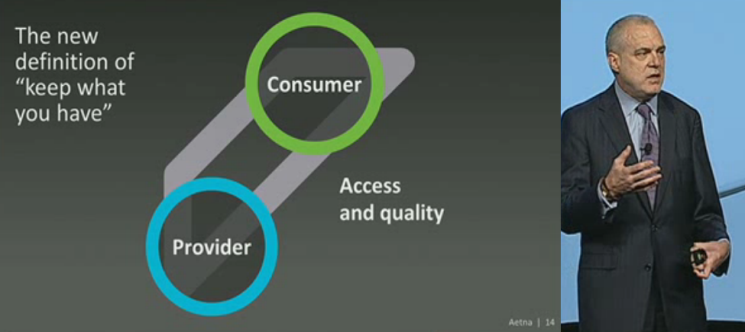
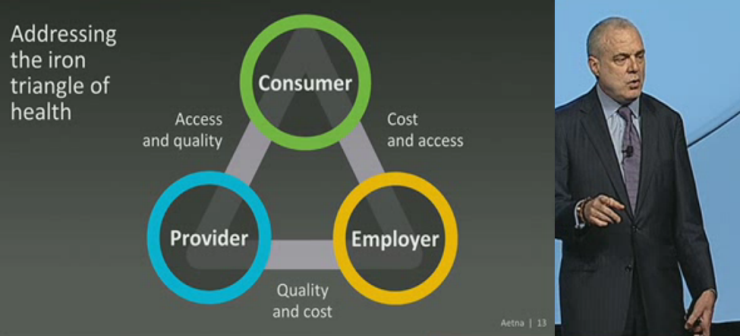
Below are pictures of Bertolini with his current versus future health care relationships.

Bertolini 1

Bertolini 2

Where did the Employer circle go?

The whole Forbes article can be seen here. http://www.forbes.com/sites/danmunro/2014/02/24/aetna-ceo-bertolini-outlines-creative-destruction-of-healthcare-at-himss14/

Aetna is not just talking. If you look at Aetna’s acquisitions and partnerships over the past few years you can see that Aetna is preparing for a future that Bertolini describes in his presentation. They have spent billions of dollars acquiring technologies that can be critical to the future in managing health care and health care information including:

iTriage – Mobile App for employee to check symptoms – Find doctor – Make Appointment

ActiveHealth – View and Update PHR – Personalized Alerts and Content – Communicate with Doc

Medicity – Promotes Coordination of Care – Real-time Patient Data

(Source: Aetna 2013 Investor Presentation)

Most of these technologies and services are housed under their company Healthagen. According to Aetna’s website Aetna was ranked #52 on InformationWeek’s 2013 list of the 500 leading technology innovators, surging ahead of many of the top names associated with technological innovation. Aetna ranked first among health insurers.

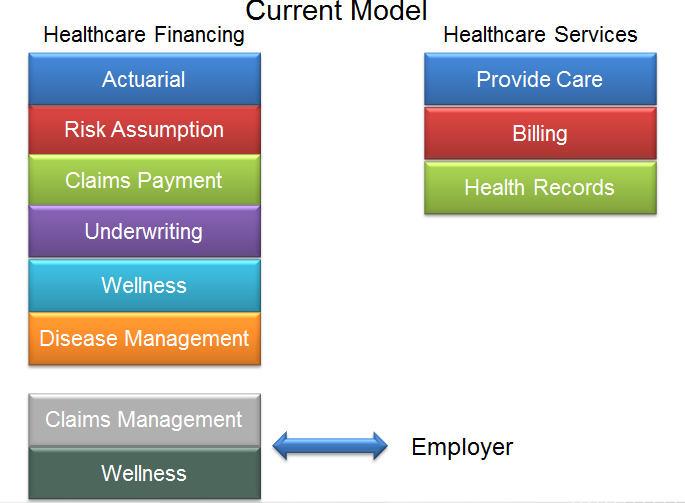
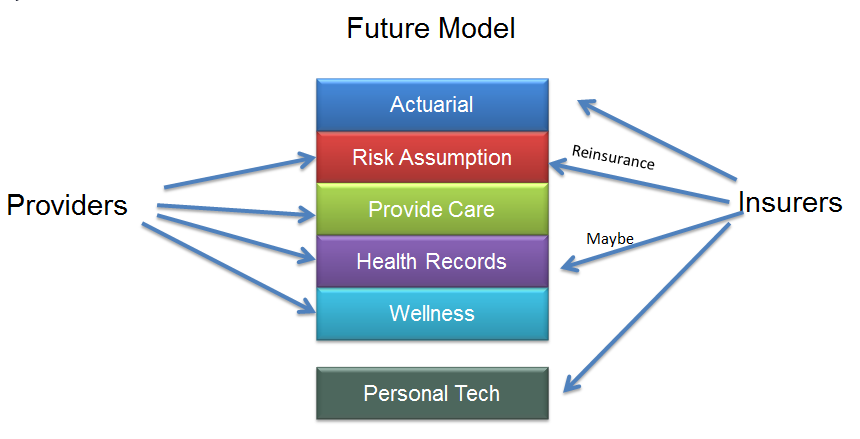
To move to this new model health care providers will need to add capabilities that insurance companies presently have. For example, hospitals provide care but they don’t have the actuarial skills to price their patient population in the event they were to get into the risk business. Many also don’t have the capital to assume risk. Those with enough capital can simply buy an insurance company. Others will have to partner with an insurance company that has the capital and reserves to share risk and provide the needed services. In the slides below I show the current and future division of services.

Current Model

Future model

So if I am an insurance company I can either buy providers to stay viable or provide some products, services, or capital that the new health care systems will need. Buying hospitals or physician groups across the country can be very expensive. So it may appear that a company like Aetna is setting itself up to be the technology, actuarial, reinsurer, and other service provider for these future health care systems. I won’t claim to know if Aetna thinks the market will move as far as I am saying, which is to a Kaiser-like model, but they certainly are preparing for a different health care model.

Some may think that this is somewhat what insurance companies are doing today. Here is the critical difference though. Today the risk sharing arrangements are still in a fee for service environment. In the future a hospital system may be in close to a 100% capitation environment. Provider systems that purchase these services and/or develops a risk sharing relationship with an insurance company in such an environment can’t have two such relationships. They will need a single risk pool to properly manage the population and risk. There won’t be a Blue Cross version, a United HealthCare version, and an Aetna version of a local ACO/Staff Model system.

A good example of healthcare financing is my own healthcare. Since I moved back to Massachusetts 16 years ago I have had the same primary care physician and used the same hospital facility on a number of occasions over that time. Yet I have had 7 different health insurance programs. Assuming an average insurance premium of $10,000 per year for my family, over the 16 past years I have paid $160,000 in premiums. I understand insurance, spreading the risk, and all the other insurance arguments about where that money goes, but think of how it could be different if all $160,000 went to the system that was actually providing me and my family care.

What Benefit Brokers Can Do

Ok, so the world may change. What would I do if I were a broker today to prepare for this change? First, change does not happen easily and overnight. The whole country of health care consumers, distributors, providers will need to adapt. As a benefits broker your buyer may no longer be the employer but the employee. If this is the case then some existing services may not be needed.

  • No more risk analysis/actuary and underwriting
  • No more claims analysis tools
  • No more wellness programs to reduce health care costs
  • No more Disease Management Programs
  • No more company medical renewals

Before someone points out the obvious to me I will say that I do know most groups with less than 100 employees are community rated and those over 100 employees are experience rated. Small employers are still faced with balancing budgets based on their health care renewal. This anxiety will go away.

Most of these types of services are a core competency of many of the national and larger independent benefits brokerage organizations. These services are viewed as key differentiators. For these firms change may be even more dramatic because providing these types of analytical skills is part of their culture.

So let’s talk about the things brokers can do. I am going to break this down to a list of tasks.

  1. Understand What the Players in Your Market Are Doing – Brokers should start analyzing their local medical market and see what the providers are doing in this area. Have they made acquisitions? Have they created new partnerships? What is their leadership saying publicly? Whatever they say or do, believe them.
  2. Add Employee Call Center – Employers will welcome the support in helping employees move to a new environment. Provider systems will welcome and pay for the support in helping those same employees navigate the market.
  3. Add Personal Financial Consulting – It is estimated that close to 40% of employees lose some productivity at work due to financial stress. The health care insurance purchase is going to be a major decision for an employee and it should be made in the context of an employee’s entire financial position.
  4. Understand the New Technologies – How many of you that have read this up to this point understand what Aetna’s technologies for the consumer are? Do you know how to Bluetooth your weight from a scale to a smartphone? The place of employment can also be a great place to help employees with technology to track health information. Could an employer have a scale at work that is Bluetooth enabled to send a person’s weight to their Smartphone? Could the employer have a blood pressure machine at work? How about setting up a private room with teleconferencing capabilities so an employee can consult a doctor face to face via the web without leaving the place of employment? Could a broker make themselves available to consult employees one on one as to how this whole system will work?
  5. Develop Technology Engagement and Education Strategy – After you learn what you need to know in number 4 above are you ready to deliver. I believe the provider systems (the new Kaisers) will welcome the opportunity to educate the population through the employer. At the employer level you can reach a large amount of people fairly easily. And the employers will care that their employees understand this new health care delivery system. Employers don’t want stressed employees because stressed employees are not as productive. I believe employers and these new provider systems will pay to help and automate these individual consumers.
  6. Invest in New Internal Technology and Processes – If your entire infrastructure is geared around engaging the employer then things will need to change. Can you record a phone call? Can you engage in online chat with an employee? Are you prepared to sell individual insurance? To sell a high volume of individual policies and service employees you will need extremely efficient internal operations.
  7. Start Thinking About Helping Employers Exit the Risk Business – Rather than advise employers how to control costs and mitigate risk should they start advising them on how to get out of the risk business? I guess Private Exchanges and defined contribution plans are the start. However, if the health care market changes then this will also change fast because there will be more options for the employer to get out.
  8. Engage New Providers – Carrier reps are always calling on brokers, but these new organizations may not call on brokers in the same way. You may need to reach out to them. If you have something of value for the new provider system such as some of the things listed above would they have an interest in paying you for your services? You will need to engage them.

Numbers 1 through 7 may sound fine but getting there is the tough part. To move to this new model it will require brokers to invest in technology and people. To attract the provider systems by providing some value benefits firms will need to have the services, size, and scale to deliver. Most independent benefits firms either don’t have the capacity or capital to move to this model. They will either have to sell to a larger firm or join forces with their peers who share the same vision and are willing to collectively invest in preparing for the future. The national firms and larger independent firms with the capital and resources will need to have the will to change.

In today’s environment many brokers may not feel the need to make these changes. Other firms have already started preparing for a much different future. For example several of the national firms have opened call centers for employees. Whether that is for a future market I have described or simply to service employees today I don’t know, however it is a sign the benefits game is changing.

I may not end up being right with my market predictions, but my advice is to pay close attention. There is change going on out there and I think a picture of the future is being drawn that looks much different from the health care market today.

It’s Time to Ban the Term “Value Added Service” from the Benefits Broker Business


I hear the term “value added service” used in the benefits world all the time. Brokers always tell me about their value added services. What does value added service mean anyway? For most it implies “free”. We all know that nothing is free. I think it is time to bury this term. In fact I think it actually has negative implications in many ways so let me tell you why.

I googled the term “value- added service” to see how firms would define it. One definition I found came from a website www.wisegeek.com. They defined the term as “options that complement a core service offering from a company but are not as vital, necessary or important.” I guess that sounds right. For most benefits firms “value-added service” means, “I am going to give you something for free that I generally don’t do.” And I agree with the above definition that says it is not as necessary or important. The problem with what I see many benefits brokers doing is putting this label on things employers feel are important. If I am an employer and have something important to me who would I get it from, a vendor that makes it a core service or one that labels it a “value-added service”? If it is important then I would hope whoever I buy such a product or service from is good at it.

Value-added services for most brokers are listed on the last pages of their proposals. It is the fifth tab from the left on their website. It is the final 5 minutes of a sales presentation. It is presented with a level of importance that is, well, not important. To me value added service is like buying a hamburger at a Chinese restaurant. They don’t really want to sell hamburgers but for those adults with kids that don’t like Chinese food they do have something for them. If I wanted a hamburger I would go to Five Guys and not a Chinese restaurant.

In the benefits world some things that many brokers have labeled as value-added services are really becoming core to what a benefits broker should be doing. I won’t get into what I think all these services are but if the employer feels the services are vital then they will dismiss the firm that labels the service as “value added”. It will appear as unimportant. If a broker can’t make it a core service then maybe they shouldn’t be providing such a service at all. And if another broker is offering such a service as a core service then your labeling it as “value-added” may be detrimental to making a sale.

So there you go. The term “value-added service” shall be forever banned in the benefits world. And I will add that as a consultant to brokers this advice is not a value added service. It is what I do all day.

Do You Want Wellness Newsletters or Do You Want a Competitive Advantage?


I was making a presentation to a brokerage firm a few years ago about how they can position their firm more competitively in a rapidly changing environment. In the middle of the presentation one of the producers asked me a question and that was, “Do you have Wellness Newsletters”? It was an odd question at the moment because it came out of left field but it was indicative of what was going on in the benefits brokerage community. With the benefits brokerage business being somewhat commoditized and more competitors entering the space benefits brokers have been looking for that “silver bullet” –  that one thing that they think could separate their firm from the pack. That silver bullet that can help them attract new business.

Vendors have capitalized on the benefits brokers desire to find the “silver bullet” so their advertisements and sales pitches promise a “competitive advantage”.  Then they say you better buy/sell their product or the broker down the street will first. And of course when that broker buys in, you, the procrastinator, the indecisive one, will lose.

That gets me back to this producer who asked me for Wellness Newsletters. My response to his question was, “Do you want Wellness Newsletters or a competitive advantage?” Somewhere along the way he was sold the idea that Wellness Newsletters was something he needed and that would give him a competitive advantage. And of course the broker down the street was offering their clients Wellness Newsletters. He responded to my question by acknowledging he was looking for a competitive advantage. The marketing machine of some company had convinced him that Wellness Newsletters was a competitive advantage. I can tell you Wellness Newsletters are not a competitive advantage. In fact my benefits broker emails me a Wellness Newsletter every week. I immediately hit “Delete”. First, I never asked for them and he never asked me if I wanted them. They just started to show up. Second, I already subscribe to a WebMD Daily Newsletter and I don’t need his.

This gets back to the bigger problem for benefits brokers. For the past 10 years they have been sold a “competitive advantage”. First it was benefits websites, then Wellness Newsletters and Compliance Alerts, now it is online HR Libraries, and HR Call Centers. All cost the broker money and none of these solutions delivers a relevant competitive advantage. Usually, within a short period of time, every broker is offering the same thing – it doesn’t generate any new business – and they are saddled some multi-year contract and ongoing expense. While the broker was looking for some way to tie the client to them it is the broker who actually is the one being tied down or handcuffed to some vendor.

So what should a broker do? First I would say start with solving real client problems. Don’t follow the guy down the street. Think logically and don’t respond to every sales pitch or press release you see about how some broker is doing some grand thing. Ask your clients what they want and make sure they know you are the resource to solve their real problems. By approaching the market in a thoughtful way and by doing proper strategic planning you will feel secure with your market position and not have to worry every time you here of some wild promise of some grand thing.

The Coming Obsolescence of Stand-alone Benefits Enrollment Systems


Let me start by saying that I realize the title of this article alone is going to be met with objections and criticism from many in the benefits technology business, some of who are my friends. It is also not something that I wish upon the industry. But as a consultant to the industry I have seen the trends for some time and the time has come to declare that the demise of stand-alone benefits enrollment systems is in sight. And it is time for all who either own such a system, sell such a system, or use such a system to prepare for the inevitable.

The beginning of the end started in 2006 when ADP acquired Employease, which at the time was one of the largest benefits enrollment vendors in the space. This was followed in 2007 by the acquisition of Benetrac by Paychex. These leading payroll firms made these acquisitions not because they wanted to be in the benefits enrollment business, but because they recognized the opportunity and the increasing market demand by the employer market for a single system to manage HR-Benefits-Payroll. Since that time they have quickly become the leading benefits enrollment companies in the U.S. with ADP controlling approximately 45% of the market and Paychex 26%. [i]

While I recognized this trend as early as 2002 I first wrote about it in an article published in Employee Benefit Advisors magazine in September 2009 titled, “Payroll Firm, PEO’s, and BPO’s Have Got it Right”. (See this in the Article Section in my blog at https://joemarkland.wordpress.com/past-articles/) In this article I pointed out that employers would be looking for a “single system that stores all HR, benefits and payroll information”.  Many employers don’t want one system to track someone’s pay, another to track benefits, and a third to track someone’s vacation days, performance, and other data that an employer may track on an employee. Employers don’t want to makes changes to 3, 4 or 5 systems if an employee simply changes their address. And “for employee self-service, accessing one system to see all pay, benefits and time-off information is much more user-friendly”. I often compare this merging of systems to the iPhone. At one time I had an iPod, a camera, and a cell phone. Now the iPhone and the rest of the smart phone market has all three features in one.

At the time I had written the article and on many occasions since I have claimed that the transition to a single platform would occur in about 5 years. We are now a little over three years since the article and based on recent market activity and my assessment of that activity, I still believe this to be true. My belief is based on statistics gathered from my own company’s customer base. As an HR and Benefits technology advisor to benefits brokers, and by extension their clients, we conduct needs assessments and recommend HR-Benefit-Payroll solutions to employers. They use this analysis to make purchase decisions. We work with anywhere from 20-40 employers per month and have been doing so for about 10 years. Over the last 36 months we have seen a huge shift in demand with stand-alone benefits enrollment systems moving from 55% down to 10% of our activity. The following chart shows our data as to the type of systems employers have been requesting in our assessments.

Benefits Enrollment Only

HR-Benefits-Payroll

2011

55%

45%

2012

35%

65%

2013

10%

90%

The HR-Benefits-Payroll column in the above chart may represent systems that either are HR and Benefits or HR-Benefits-Payroll. Keep in mind that we are introduced to these employers by benefits brokers, so one would think the statistics would lean more to benefits enrollment only systems. That is not the case. Employers, by a 9-1 ratio, are predominantly looking for a single system. This statistic not only plays out for new customers. We are also witnessing a significant migration of existing clients that use benefits enrollment systems convert to a single HR-Benefits-Payroll solution. Over 95% of those that have changed systems have transitioned to a single platform.

Other than the obvious, which is the employer’s desire for a single system, I attribute this rapid conversion to the following:

  1. Increase in number of vendors – Any competitor to ADP or Paychex has had to develop similar capabilities. While some are still evolving, the number of vendors offering these capabilities has grown tremendously creating a greater awareness in the market while giving employers more options
  2. Reduction of HR Staff – Employers want to the reduce costs related to corporate overhead. HR is one area. Therefore efficiency in HR by leveraging technology is a goal for many employers.
  3. Compliance – HR and Benefits is getting more complex. Employers need to organize their data to stay compliant. The reporting needed for the Accountable Care Act is an example of this. Payroll Companies have led the way here with this type of reporting.
  4. Employee Self-service – Employers do want to expand employee self-service in an easy to use way. A single point of entry to all HR-Benefits-Payroll information provides a better and easier employee experience while reflecting well on the company.

Many benefits brokers and benefits enrollment companies will debate these statistics. Around the industry benefits enrollment vendors are having an outstanding year in 2013. I expect 2014 to be just as promising. I believe this can be attributed to several reasons. The first reason is that many benefits enrollment systems are either fully funded or partially funded by benefit brokers and/or insurance companies. Brokers and carriers continue to use technology and what I call “giveaways” as a differentiator or to sell product. In the past it was benefit websites. Today it is benefits enrollment systems and HR Call Centers. These free or discounted systems and services creates a false perception of market demand. Many of these systems were implemented without ever having gone through an analysis to determine employer needs. Why should they, in many of these situations the employer is not making a purchase decision. It is the brokers, carriers, or whoever is funding it that is the customer of the benefits technology vendor. I would estimate that close to 50% of the stand-alone benefits enrollment systems are funded by some third-party.  Of systems my firm has implemented that number is closer to 75%. Competition in the benefits brokerage business has increased the number of “free” enrollment systems but this does not represent a real increase in employer demand for such systems. Give away anything for free for a day and I will show you an increase in demand.

Now along comes health care reform and the threat of reduced compensation from medical insurance. How many stories have you read about how a broker can make up for lost medical commission by selling more voluntary and worksite products? This push has resulted in an even greater funding of benefits enrollment technology by insurance companies that sell voluntary and worksite products.

For a while I thought the development of Private Exchanges would give the benefits enrollment companies some reprieve. I still think it may for a year or two. With Private Exchanges the technology bar has been raised and the enrollment technology vendors have had to add functionality to handle defined contribution plans and provide decision support tools to help employees make better insurance purchase decisions. In my opinion this technology edge will be short-lived as all other vendors will have to add these capabilities. In my short experience with Private Exchanges I still have found the majority of employers wanting to run their Defined Contribution Plan or Private Exchange within their existing HR-Benefits-Payroll technology. Using third-party tools I can Private Exchange-ize almost any HR-Benefits-Payroll system. With all these new employee contribution methods and the increase in voluntary products I still find the ease of making the payroll deductions a primary requirement of the employer. This once again puts the single system vendors in the driver’s seat.

My predictions come in a year when benefits enrollment company Benefit Focus went public and raised around $75 million in their IPO after showing a previous 6 month operating loss of $15.2 million[ii] . More recently Towers Watson acquired benefits enrollment company Liazon for $215 million. I think both may disagree with my labeling them as benefits enrollment technology companies but that is how I see them. That is the goal isn’t it – to enroll people in their benefits? As for the money aspect of these transactions I say “good for them”. They capitalized on the opportunity. However, neither of these events changes my opinion as to where the market is going.

If broker competition, health care reform, the push to sell more voluntary products, and the advance of Private Exchanges is creating more demand what is going to stop the advance of benefits enrollment only solutions? The answer is two-fold and includes increased employer demand on one side and the ever-growing vendor market providing the supply. In the end logic will prevail and employers will get what they want which is a single system; and the army of payroll vendors, HRIS vendors, HR Consultants, and even some benefits brokers will educate the market and deliver the solutions. I guarantee that brokers who work with me will be delivering such systems. Think of this for a minute, ADP has around 800 sales people calling on employers every day and they are just one company. Collectively there are thousands of sales people calling on employers to deliver these solutions. They will move the market.

The transformation has begun but will still take some time. In the near future mergers will happen between enrollment vendors, payroll vendors, and HR vendors to meet the market demand. Some stand-alone enrollment systems will survive to meet the needs of those clients with very complex benefits or those who want best in class solutions. This will more likely be in the 1000+ employee market, even though many larger companies such as Nokia with 50,000 employees are implementing a single system. (See http://www.computerweekly.com/news/2240210585/Nokia-Solutions-Networks-HR-rejects-best-of-breed-for-best-of-platform ) In the less than 1000 employee marketplace I predict that by the end of 2015 you will see an even larger percentage of the market convert to a single system for HR-Benefits-Payroll. If you are in the benefits business then you will have
to make some changes to prepare for this market change. Or, I could be wrong. I presented my facts so that you may decide.


[i] HR Technology Advisors 2011 Study

[ii] Street Insider August 14, 2013

It’s Time to Simplify Benefits


Since I have been in the benefits business, either as a distributor or as a technology advisor, benefits communication has always been a problem and a topic of discussion. Brokers and employers have been developing fancy benefit booklets or creating detailed benefits statements all in an effort to get employees to understand and appreciate their benefits. Now with the advent of the web, brokers and employers have built websites and developed videos to give employees access to benefits information 24/7 often only to take them down a year or two later because nobody is using them. Trust me, I have seen hundreds of utilization reports and very few people are using these sites. Yet, after all this effort the majority of employees still don’t understand their benefits. I say enough already! Why don’t we try to make things easier? Well I have some suggestions.

Let’s start with the health insurance business. When I got in the business in 1986 many plans were still straight deductibles and coinsurance. In fact, one of the most popular products was the Guardian Insurance $100 deductible 100% plan. While I realize this type of plan was not sustainable financially, I will say it was simple. Concurrently there was the growth of HMO, PPO, and POS plans. Along with that came all kinds of copays and new rules on whom you had to see first before you saw someone else. Now there are HSA’s and HRA’s sold with high deductible plans. I think it’s funny that they call high deductible plans, Consumer Driven. Wouldn’t it have been easier if we just took a straight $100 deductible 80/20 to $5000 plan from 1986 and adjusted the deductible and coinsurance every year for inflation?

Today health insurance is very confusing and it’s going to get worse. I think my prescription drug card today has like 8 different copays. Recently I had treatment for a health condition and between my primary care physician, the specialist, the hospital, and the lab, I have so many bills I had to bring them all to the office and try to figure them out. Each bill had about 6 different figures on them. Between what they were billing, the discounts, copays, deductibles and coinsurance I could not figure things out. It’s been two weeks and the bills are still on my desk. There is no way the average American is going to figure this out. I have such a headache from this I need to see a doctor.

While I do realize the logic for creating these monster plans, it simply hasn’t worked. The health insurance business is becoming like the tax code. Everyone is manipulating the system to modify behavior. If you want people to buy more cars then you give a “Cash for Clunkers” tax credit. You want people to buy more houses you lower interest rates and give people an interest deduction. You want people to stop using Emergency Rooms you give them a $100 ER deductible. And that gets me to my prescription copays – I simply punt on that one. When I go the Pharmacy I just say “tell me what I owe you”, and I assume the pharmacy is telling me the truth. I have no idea whether the drug is name brand, generic, generic plus, or whatever new category has been created. Enough already!

Personally I think this whole country could operate on about 10 easy to understand health insurance options. As an employer and employee would I care? No. I don’t need all those options. I would bet that I could develop 10 plans that would be within 3% actuarially of every plan in America today. What I believe is that other than all the little nuances in health care plans (that nobody understands) the majority of plans in effect today are almost exactly alike. Imagine how easy it would be for employees, doctors, hospitals, etc… to understand and administer such plans. This would not eliminate competition. It would make Aetna’s Plan 1 the same as Blue Cross and United Plan 1. I would go to the doctor and say I have Plan 1 with Aetna and everyone would understand. To make things even easier I would go back to straight deductible and coinsurance plans. Obviously this is not going to happen with ObamaCare. Just think of what a $100 deductible 80/20 to $5000 plan from 1986 would look like if you adjusted the deductibles and copays for inflation.

I could go on and on with other insurance coverages. Your Spouse can buy Voluntary Life equal to 50% of the employee amount but the employee can get no more than 3 times earnings to a maximum of $150,000 when combined with the Base Life paid for by the employer. And if the employee is 65 and is subject to a reduction schedule it needs to be multiplied by 65% assuming his birthday is closer to the last renewal date than the next one. What?

If you are a benefits broker or insurance company the idea of making things easier may be considered blasphemy. I can hear all the arguments already. But one really has to honestly ask, does anyone really care about all these plan differences? Personally I don’t think so.