
Category Archives: HR and Benefits Technology

The Health Insurance Balloon is About to Pop


If you are reading the headlines about Obamacare lately you can’t miss the articles about how 2017 is going to bring significant increases in health care costs. Here are some of the headlines:

“The Pennsylvania Insurance Department says insurers have proposed premium increases averaging 23.6 percent for individual coverage for 2017.” (NY Times)

“Obamacare 2017: Health Insurance Costs are Ballooning – Texans’ Premiums Will Soar By Over 55%”

And according to the Wall Street Journal premium increase proposals for some states are as follows:
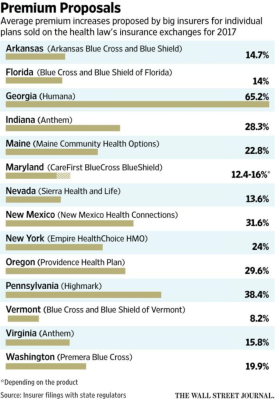
NY Times List

As I had mentioned in a previous blog these increases are not sustainable. That being said, I think the health care balloon is about to pop. And this is not just the exchange plans. It is the health care balloon which includes all plans. Let me explain.

Those in the health insurance business are familiar with the term “squeezing the balloon”. The implication is that when you try to control health care costs in one place it often pops up somewhere else. The cost of health care doesn’t go down it just moves from one place to another. The balloon gets squeezed but does not shrink. In fact, the health care cost balloon keeps on getting bigger and bigger.

For the past 20 or so years benefits brokers have been trying to help employers manage costs but have seen little success. For the most part there is very little a broker or an employer can do because there are simply too many things outside of one’s control to control costs over time. So the whole industry has mastered the art of helping employers find better risk pools. PEO’s try to attract employers by moving firms into a larger risk pool. Smaller and smaller employers have been moving to self-funded plans. Now we see “Captives” which is essentially a methodology of creating another risk pool. The idea for many of these employers is to get smaller employers out of small group community rates.

This idea of having all these different risk pools is quite interesting. Even the insurance companies create different risk pools. They have their individual insurance pools; their small group pools; and their large group experience rated pools. They put these employers in different buckets and mange those buckets. It almost seems like within a single insurer they have their own death spiral going on. By segregating their risks eventually, the smart companies or individuals will find a way to get into a better risk pool leaving the bad risks in another pool.

It is my belief that the government, and maybe society in general, will not let this persist. There are already complaints about the “game being rigged” resulting is income disparity. In some ways the health insurance game is heading in the same direction too, with different groups of people having much different experiences. I will not get into risk and underwriting here because it really doesn’t matter. If a large part of society can’t get affordable health insurance it is everyone’s problem.

The day may be coming where there may no longer be a place to hide. In a recent NY Times article Kurt J. Wrobel, Chief Actuary of Geisinger Health Plan stated:
“Our rates for Medicare, Medicaid and employer-sponsored insurance have been relatively stable, but those products have to bear the cost of our losses on exchange business,”

Geisinger requested a 40% increase for their exchange plans for 2017. If they don’t get it they have to make up for the losses somewhere else.

This health care cost problem is not going away. In fact, it is getting worse. I often tell my staff that when you see a problem staring you in the face, do something about it. The health insurance problem is staring us right in the face, right now, and if the industry doesn’t do something about it then someone else will. That someone in the U.S. is the government.

Many have said that the reason incomes are flat is because employers have been bearing the brunt of the health care cost increases over the past 5 years. Health care cost increases are consuming dollars that could be used to raise wages. Employees have been also getting hit with higher contributions for health insurance. Flat wages plus higher health care costs equals a negative income.

This problem is coming to a head. The balloon has no more capacity. Will 2017 be the “tipping point” that will force changes in unprecedented ways? I think so and there may be no place to hide.

Understanding the Benefits Broker Role in a new HR Ecosystem


This was written for Employee Benefit Adviser Magazine. The link to the article on their blog is here.

When the iPhone first came out in 2007 there were no apps other than what Apple provided; no third-party products like phone covers, car chargers, headsets, or wireless speakers. If you dropped the phone and broke the glass you couldn’t take it to the local mall to have it repaired.

Here we are nine years later and there are over 1.5 million apps. There are add-on products sold online, in pharmacies, convenient stores, airports, and all kinds of other retail stores, that make the phone more useful. If you wanted to write an app for the iPhone there are skilled programmers available around the world. And if you dropped your phone there is some person at the local mall who could fix it.

The majority of these products and services are not provided by Apple. They are provided by some person or company that one day made a decision to capitalize on the success of Apple and build something that users of Apple products would value.

According to the Financial Times, “technology ecosystems are product platforms defined by core components made by the platform owner and complemented by applications made by autonomous companies in the periphery…the core firm’s product has important but limited value when used alone but substantially increases in value when used with the complementary applications.”

In the HR/Benefits technology world the same rules apply. There is a core product and there are periphery products and services. A core product with an advanced ecosystem will have much more value. If you are an advisor in the benefits business it is important to know which products are core and which are periphery. If you are providing services it would be important to know how your service fits into the HR/Benefits tech ecosystem.

Many benefits brokers are not recognizing these HR technology ecosystems. Many think the benefits technology vendor they have chosen is its own ecosystem or the center of the clients HR world. At one time people thought the Earth was the center of our solar system too. This belief caused many problems with keeping the calendar, sailors navigating at sea, and keeping track of Holidays.

Thinking that benefits technology is the center of the HR Ecosystem also results in problems. Benefits aren’t easily administered or communicated. Systems delivered by brokers often aren’t easy to use or have issues with “integration”.

Working in a vacuum delivering siloed software creates the problem.

The HR technology market is in the midst of big changes. The market leading vendors are making efforts to grow their ecosystems to create more value for employers and employees while also creating space between themselves and those that want to take their business.

If you are a benefits broker it will be important to recognize this market change. You need to make decisions as to who you think the winners and losers are going to be. You would need to think about how what you do will fit into these HR ecosystems. This could impact everything from the products one sells, advice one gives, and the services one provides. Private Exchanges, benefits administration and communication are all impacted by how the HR ecosystem evolves and how these products/services fit in.

When it comes to benefits technology I always remind brokers that it is important to understand the tools of one’s profession. Understanding how technology impacts the benefits business does not make someone a technologist. It makes someone a better broker.

HR Technology is going through an evolution much like the cell phone business except we are 7 years behind. A few years from now there may be fewer vendors with much bigger ecosystems.

Providing some product or service that enhances the value of the right core HR technology solutions is an opportunity that can become very lucrative. At a minimum understanding the “tools of one’s trade” is a requirement to simply being a better benefits advisor. Either way, pay attention, because the HR/Benefits technology world is about to change.

Webinar Announcement – Introducing HR/Benefits Technology 3.0 – A Whole New Technology Engagement Strategy for Benefits Brokers


I am conducting a webinar for benefits brokers that introduces HR Technology 3.0. If you are a broker and interested in attending click on this link here . The dates are June 3rd and June 7th at 12:00 EDT. This will be a good one that I have been developing for some time and have done a lot of research. If you are in the benefits business then I think this will be valuable.

Here is my overview.

Just when you think you’ve figured out the HR/Benefits technology marketplace, the market changes and a whole new HR Ecosystem arrives. What you thought was right just a month ago may no longer be as HR Technology 3.0 is upon us. With $2.1 billion in new investment capital coming into the business, it is going to come in like a storm. It is an opportunity for benefits brokers to approach prospects with a whole new idea that is intriguing, forward thinking, that can deliver outcomes in the HR area that few employers have realized.

In this webinar we are going to introduce HR Technology 3.0 and paint the picture of how brokers can bring this to market. We will even role-play the sales presentation that we think can create the wedge needed to upend existing relationships. The agenda is as follows:

What is HR/Benefits Technology 3.0?
How this changes the broker/employer conversation
What technology vendors will be the winners and losers?
What is the broker’s role in this new world?
Role play of a prospect presentation.

This is only the beginning for Zenefits-style brokerages


This was originally written for Employee Benefit Advisor Magazine. The original post can be seen here.

As this election year unfolds, many are questioning what created Donald Trump. Why him? Why now? On the other end of the spectrum, the same could be said of Bernie Sanders. In the benefits world, I relate this to Zenefits and former CEO Parker Conrad. What is it that allowed Zenefits to come to be? As Zenefits now re-groups to begin its post-Conrad journey, firms like Namely are getting press and stepping into the market in a similar way.

Some will say it is the Silicon Valley arrogance that breeds and often enables young entrepreneurs to create new companies and attack the market and competitors with a vengeance. These young guns want to disrupt the market and change the rules of the game to deliver something new and better.

Whether you agree with the Zenefits model or not, one can’t argue with their results. According to Bloomberg, their revenue was close to $63 million annually as of the 4th quarter 2015. This means that:

• $63 million in customers fired their broker because Zenefits promised something their current broker was not delivering.
• $63 million in customers valued what I think is the equivalent of a $5 PEPM technology more than they valued the services delivered by their $25-$35 PEPM benefit broker.
• $63 million in customers did not care that there was no local service.

While Conrad has left this stage, the conditions that allowed him to grow his business still exist. And I am sure the Zenefits executives and investors — including Andreessen Horowitz and Fidelity — aren’t going to let $63 million in revenue slip away without a fight.

What Zenefits did do is let the world know that there are many employers out there that value what Zenefits promised to deliver. In fact, according to industry analyst and marketing guru Mark Mitchell of The Starr Conspiracy, there was $2.1 billion invested in the human capital management technology and services space in 2015, and $600 million in the first quarter of 2016. As Mitchell said at a recent conference, “Those checks are being cashed.”

What is about to come is a tsunami of new products, services and marketing in the HCM technology and services areas that are going to hit the market. Employers will be getting phone calls, webinar invites and attending conferences where these new solutions will be heavily promoted.

Case in point: Had you ever seen a TV commercial or heard a radio commercial about HR technology before Zenefits and Namely? This is a hot market, and as one venture capital firm representative said to me, “We are only interested in investing in firms that go after the benefits commissions.”

The commission is in play, and $2.1 billion in investment capital knows it.
I have been in the benefit business since 1986, and many of the same problems still exist. Administration is still complex. Benefits are still confusing, and getting more confusing. Costs are still going up. And now, in today’s world, cost shifting onto employees is creating financial stress on employees. It is getting worse, not better. As long as the current market does not solve these problems, then there is an opportunity for someone else to do so.

In the political arena whether Donald Trump wins or loses somewhat does not matter. The conditions that created him and allowed him to get the nomination aren’t going away. Certainly the millions who support him won’t disappear overnight. They are still Americans living in our society.

In the benefits world whether Zenefits survives or not also doesn’t matter. The conditions that enabled them to enter the market and grow still exists. Employers still want what Zenefits promised. Managing benefits is still burdensome. Costs are still going up. People still don’t understand their health insurance. The market conditions have not changed. The opportunity for another Zenefits, or 10 of them, or 100 of them still exists. And while Parker Conrad is in the rear view mirror others are coming. And it will be a tsunami.

Insurance Education is Poor and on the Wrong Path


I have 6 brothers so when I reference a brother in a blog it is not always the same one. A few weeks back one of my brothers was telling me how he thought his car insurance was a rip-off. He said he is always paying for it and never had a claim. So I said, “well, why don’t you take your car and drive it into a tree and then you will get your money’s worth”. Insurance gets a bad rap. However, I think it is the industry in general that does a poor job developing products, educating consumers, and clearly stating their value proposition.

One of the reasons insurance gets a bad rap is that nobody really understands it. Another is that while the majority pay the minority get some form of payment in excess of what they paid in. Insurance, for the most part, is about having peace of mind. I try to tell my brother, imagine driving a brand new car through Manhattan or in the snow with no insurance. You would be very cautious. If your car was very used then maybe you wouldn’t care, but with a new car it would be different. It is knowing you have insurance that makes it easier to navigate tough situations.

Insurance It is not intended to be perceived as some form of savings plan or reimbursement policy. Insurance is designed to protect someone from an unanticipated event that can cause significant financial loss and harm. This also has been lost on the market and in the narrative. Since when should an office visit be considered an insurable event? People spend more money on Starbucks in the morning or going to the movies or out to dinner on weekends than they do on health insurance out of pocket costs. And what is the average monthly cell phone bill for a family?

Most people also don’t understand how insurance is priced. In fact, one of the major problems with health insurance is that it is essentially a one-year term policy. Medical insurance should give people options like Life Insurance so they can see the costs over their lifetime. If I buy an annual renewable term policy I would see how the costs go up every year as I get older. However, if I bought a 30-year level term I would see that while I pay more when I am young relative to a one year -term, I am paying less as I get older. I understand rates would need to be adjusted for inflation. But people don’t understand this. They need to understand their costs over time to realize why you have to pay more when you are younger. I thought one of the biggest mistakes of Obamacare is the age rating. It is started this division between old and young. “Why should I pay for the old guys?”

People also think the government will take care of things if you don’t have insurance, or you can go to a hospital and get treatment without having to pay. With disability many think the government will step-in. That belief of a safety net makes it too easy to take chances. I know so many people on social security disability it is unbelievable. And I know they can work. It seems too easy.

So what are my solutions? First, make a law that says health care costs are not exempt from bankruptcy. If that is the case, then every parent will be telling their child to not take the chance of ruining their financial lives by not buying insurance. Every financial planner would make buying health insurance a priority. Second, health saving accounts should be available to everyone but, there should be no laws requiring the covering of expenses less than say $1000 or $2000. If ever person who turned 22 saved $50 every month for the rest of their working lives in a health savings account this would total $14,000 before any interest. Most would have enough money to cover those smaller expense for a lifetime. And don’t tell me they can’t save $50. As long as I see people walking around with cell phones I believe this can be done.

I know this blog is a little bit of a rant. I actually don’t think health insurance will be fixed without dramatic changes. I shared my opinions on how it will be fixed in other blogs. However, I also think the current narrative from the government, from insurance companies, from employers, and yes, from many brokers, is not contributing to the education of what insurance is really about. The system, in its current design, is not on a path to make things better. And I am not talking about costs. The current narrative is not educating people or giving them an understanding of what insurance is about or how much it costs. The current narrative says, don’t worry, we will take care of you.

I Got a 16 % Health Insurance Increase – This is Not Sustainable


Only 30 days in advance of my April 1st renewal date I got an email informing me that my company’s medical insurance rates are increasing 16%. For a $2000 deductible plan (we do have a HRA underneath) it now costs $20,736 per year for family health insurance coverage. For an employee making $40,000 per year this is 50% of this employee’s payroll cost. If I asked this person to pay for 100% of the increase this would be equal to a pay-cut of 7.35%. This is not sustainable. What is worse is that I have so little control over the cost and I see very few companies really trying to do anything about it.

I have mentioned in previous articles how the two biggest problems the U.S. is facing economically is the cost of healthcare and college education. I get the double whammy as a business owner who pays for 75% of my employee’s healthcare and as the father with two kids in college. I can’t win. “Thank you, sir, may I have another?” (Animal House 1978)

Between the cost of healthcare and college something has to give. Personally I think we are reaching the breaking point for employers and employees. What can be done? Do I not hire people who need health insurance? Do I hire only young people that have lowers costs? Do I start hiring all part-time people? Do I move my business to a lower cost State? Do I outsource some things overseas? One thing I know is that a business owner will do what he/she needs to do to survive so all these tactics will be used. I have always been a believer that if you show me a law or rule I can predict how people will react. You increase the cost of health care on a business and I can tell you what you will get.

I have been in or around the health insurance business since 1986. I delivered my first medical renewal with an employee rate that exceeded $100 for an employee in that year. In fact, I remember the exact client meeting like it was yesterday because the business owner’s father was dying of cancer and now I was delivering more “stress”. He was angry. I am angry too.

I am mad because this problem has gone on long enough and the industry has really done nothing about it. I am mad because I will probably have to switch insurance companies again for the 6th time in 15 years. It is inconvenient. It is stupid. I have had the same doctor for 15 years but my insurer has to change every 2-3 years. What a waste. I am mad because I will have to deliver bad news to employees and then wonder if any of my employees will start looking for a job with a company that pays more for health insurance. It is a business risk.

Here is my message to the industry. Fix it. Or someone else will. And I am no longer going to take it anymore. I am sure many others feel the same way.

The battle for power in health care has begun – Are the brokers powerless?


In this highly energetic election year health care is still one of the major battle grounds dividing the candidates and the political parties. Rubio wants to let employers give money to employees tax-free and let them buy from a broad market. Cruz said he would make an individually purchased health insurance plan tax deductible. Sanders is a proponent of a single-payer system and Hillary wants to bring the insurance and pharmaceutical companies to their knees. As for Trump, I am really not sure what his plan is. What I do know is that there are many people with all kinds of plans and they aren’t asking me what I think.

As someone who is somewhat in the health care industry along with my broker partners the industry around us can change dramatically, yet we have little power to impact change. Are we powerless? Being powerless is a very uncomfortable position especially when the outcome can significantly impact one’s business.

The cost of health care and thus health insurance is a burden on our economy, a burden on employers, and with the cost shifting to employees and higher deductibles it is becoming an ever growing burden on employees. This is somewhat a new dynamic that employers have to deal with too. It is an industry with many interested parties looking for solutions. Those that deliver solutions that can bend the health care cost curve could reap big rewards.

So who has the power to fix this? Insurance companies? Hospital systems? Doctors? Google or Apple or other outsiders with a lot of money? Government? Employers? Employees? Independent consumers? Brokers? Many are trying to solve this problem, some because they honestly care to, and others so that they have a viable future. And for those that think some are “too big to fail” or at least quit, remember this list of companies that used to sell health insurance but chose to leave the business. (Prudential, UNUM, Travelers, Guardian, Metropolitan, Great West, State Mutual) I am sure I missed many others. I don’t imagine these firms that have left the business or the ones fighting to win today care(d) about my interests or the interests of benefits brokers.

The health care system will undergo significant changes in the next 5 years. My business is dependent on the health insurance business because I do business with brokers so how the industry changes is pretty important to me. If the business did not change, then that would work for my business. If I could dictate how the industry evolves then that would be fine too. But without the power to stop the business from changing or dictating its future then those of us on the fringes of the business will need pursue another strategy.

So what are brokers to do? You can fight the change as many of the cab companies are doing to stop the advances of Uber. You can develop the solution and therefore ensure the outcome. However, I doubt that any broker is in the positon to change the health care system or have the capital to do so. You can hope it doesn’t change. You can wait until it changes and then react fast. You can quit as the insurance companies did in the 80’s and 90’s. You can also accept that the world is going to change and that you can’t impact its outcome. If that is the case then you need to exercise the power that you do have, anticipate the future, and bring some value to the market that fits in the new model.

While companies like Aetna, UHC, Google, Apple, and many provider systems are changing or investing in businesses to control health care costs, I think firms like Fidelity, Towers Watson/Willis and other large benefits firms have made significant investments to provide a valuable service to support where the industry is going. Just ask why did Fidelity choose to get into the benefits business now? Why did Towers Watson buy Liazon and then merge with Willis?

We are in an industry where we don’t get to make the rules. We are powerless and have to play by the rules imposed upon us. An insurance company can eliminate commissions with an e-mail as many have done in the individual market. The government can pass a law making individual insurance tax deductible. Carriers leave markets and hospital systems are entering the insurance business. The future is imposed on us.

Don’t think we are the only ones. Those who own Ford dealerships are dependent on Ford to make great cars. A friend of mine has a manufacturers rep business and sells power supplies. One year a manufacturer that represented 60% of his revenue decided to no longer use third-parties to sell their products and sell direct. His business was devastated though he did recover. His problem was that he did not build a business that would have protected him from this risk. Had he planned ahead it may have been different. It is for that reason many car dealers often own multiple dealers representing multiple manufacturers.

In this blog I have written articles on where I think the business is going. (The New Benefits World is Here – Though You May Not Have Seen It I am already making moves anticipating a different future. My experience with benefits brokers is that few have been looking into the future to try and predict where the market is going. Most are hoping the world doesn’t change. Others are waiting until it changes and other are simply selling. I am optimistic. I think there are opportunities for those that anticipate change and provide some value for this future market. In fact, there will be less competition because many will have waited too long to change and others simply won’t have the skills, scale, or vision to bring real value to a new benefits world.

I think a new benefits world will put power in the hands of the consumer. Think about this for a minute, if employers had the power what would they want? If employees had the power what would they want? As an employer, today’s system gives me little power. As an employee I have less. When someone delivers what I want I will say it is about time.

So what advice do I give? If I were a benefits broker, I would start studying where the market is going to go. I would ask employers and employees what they would want. I would gain an understanding of this market like no other. I would engage the companies who are working to create this new benefits world. I would make an educated guess as to where the market is going and when it will get there. Then I would look for the opportunities to provide the value. I would also start now. I have.

PS – I just got my company health insurance renewal today and costs are +16%. This craziness has to end and I feel powerless. Please help!

Simply a Better HR and Benefits World


Those who read my blogs and some of the publications that I write for know when news such as Zenefits firing their CEO hits the street I am more than likely going to have an opinion. In fact, I get calls all the time to comment on the news of the day. I guess I am as qualified as anyone to comment but all this writing I do and the webinars I conduct sometimes obscures one’s perception of what my real mission is. My “Why” has been consistent since February of 2001 when, while on the beach in Jamaica, I found out that our investors were not going to fund the needed next round of capital for our business and I had to sell the assets and find a new job. My mission that started that day continues today.

What I don’t want is to have outsiders define me or the mission of the company my partner Don Rowe have built. Just today I had one broker comment that I am telling everyone that brokers are going out of business. I don’t think that at all. In fact, I wrote an article on this blog titled, The Demise of Small and Mid-sized Benefits Brokers is Greatly Exaggerated . What I do believe is that if brokers don’t change with the times they will lose to brokers who do change or are more creative. Like any industry there will be some companies that go out of business. Capitalism rewards those that provide more value and create new things. It is responsible for innovation.

So what is driving me? As someone who understands insurance, understands the technology business, and is an employer myself, I simply think that there is a much better way to deliver and manage HR and Benefits. The problem, and I guess opportunity, is that the current structure of our delivery system is not really designed to make the changes that are possible. Some simply are protecting the status quo while others simply don’t have the capacity or maybe the vision to enact change. Heck, I may not either, but I am going to try.

I will say one of the frustrating parts is when people try to protect the status quo. I don’t think those in the industry have done enough to impact change. Maybe that is why the government got into the middle of health insurance and why firms like Zenefits pop-up. Therefore, when some change comes from an outsider that I think has a good idea I applaud it. When people try to protect the statuus quo I think they are part of the problem and not the solution.

I think the idea of Zenefits is a good idea. As a small employer their value proposition is strong. Does that mean I think they are a great company or think their founder is a great guy? No! Would I move my business to a company that made the management of my HR/Benefits/Payroll easier for me and my employees? Sure I would. Not to Zenefits but someone who did what Zenefits is promising well. Maybe it is Namely or Gusto. In fact, I have told people I would pay someone pretty good money if they provided more help in the HR/Benefits/Payroll areas. I really could use PEO like services. I only had two companies ever call me and offer to help me in this area and that is Zenefits and Paychex.

I think Fidelity entering the benefits business is a good idea too. I think that my employees should have a single place to call if they have a question about their 401K or benefits. I think that there is a relationship between which medical plan I should choose and how much I am contributing to my 401K. These decisions are related. So if Fidelity delivers a single point of contact for my employees then that would be progress. Nobody has ever offered that to my company.

When I see bad ideas I call them out too. Private Exchanges are a somewhat of a farce. The idea of giving employees more options is not a bad idea but the promise that this is real change is a joke. I sold cafeteria plans in 1987 which look like today’s private exchanges. Boy have we come a long way since 1987.

Most Wellness programs are pretty bad too. Many of these programs alienate people, probably lead to discrimination, and don’t save 10 cents in health care costs. Plus, I would not want my employer ever putting their nose in my personal business. This is getting out of hand and I think it will create friction between employers and employees. Does that mean all wellness programs are bad? No. If they make people feel better, improve productivity, or maybe build morale then that is fine. There are too many negatives in the corporate wellness programs.

I think benefits are too confusing too. Nobody understands their benefits yet nobody tries to make things easier. If I read another article about Benefits Communication I will die. I feel like yelling very loudly –  STOP MAKING HEALTH INSURANCE SO CONFUSING. Who is going to stand up and make things easier? You know who will? Apple.

The HR and Benefits world that I envision looks much different than today. As an employer I want things to be easy. I really don’t want the stress of going through a medical renewal every year. I want my employees to access information easy, on the web, at home, and on their cell phone. I want productive, happy, and engaged employees so if they are stressed financially, physically, or mentally, I would love to give them a place to call or go to get help. I don’t want my business to be at risk either. There are so many rules and laws I simply don’t know what I don’t know. I want someone I can depend on to give me good advice. I don’t want to work this hard to build a business only to have it blow up because I did something wrong that I wasn’t even aware of. I want people paid the right way. I want to record time-off the right way. I want all my benefits bills to be right and my payroll deductions to be accurate. All this stuff does not move my business forward a bit but needs to get done. Make it easy and get it out of my way.

As an employee I want health insurance that makes sense. I want my doctor to care if I am healthy or living the right way and not my employer. I would like to talk to a doctor at 1 in the morning via my cell phone when my son has an ear infection. Why do I have to go to the emergency room just to get a prescription? I always wonder why Jiffy Lube can send me an email when my car is due for an oil change but I don’t get an email from my doctor that I am due for a check-up or some other test. I would want to know how many vacation days I have left so when I am planning my vacation on a Sunday night with my wife I could look it up. I want to know the company holidays and how much time I get off if a relative died. I want to easily access my pay-stub if I want to apply for a loan. I want to have the balance of my FSA, HSA, and 401K on my cell phone. I want all this stuff in one place with one log-in, one app on my cell phone, and with one 800 number to call if I have a question. I have enough passwords in my life already so please don’t give me too many more. I already have my Excel file with my passwords list and I forgot where I put that.

And as an employer and employee I want my health insurance to stop going up 5%-10% per year. That is a dream.

In many other aspects of our lives things are getting easier. Paying my bills; managing my money and banking; communicating with my kids and my elderly parents; buying airline tickets; reserving hotels; avoiding speeding tickets (Waze App); I can go on and on. Yet, while everything I listed for above employers is available and possible today, few have achieved even a fraction of what is possible. Why is that? Why is it that people are selling “Private Exchanges” as something new when I was selling them in 1987?

Is it inertia? Is it people protecting the status quo? We are in an age where if those in any industry don’t make things better opportunist from the outside will. Trust me, people like me are thinking this way every day. Zenefits, Namely, Gusto, and Fidelity are going to try. Tomorrow it may be Google or Apple. Sounds crazy doesn’t it. Well I am not waiting.  The change I am talking about is going to be tough. It is going to take “out-of-the- box” thinking. It could take significant capital. It will require scale and resources. It may require one to blow up their own business model to move it to a better place. As the old saying goes, “if it were easy everyone would do it.” It will be tough but my partner and I are going to try. We think it will be fun too. Join us!

Zenefits CEO Resigns – In Comes the A Team


If you haven’t heard the news yet Parker Conrad, Founder of Zenefits, has resigned as their CEO. He has been replaced by David Sacks, the Zenefits COO and a Zenefits investor, who was a past executive at PayPal. You can see the announcement here along with a letter from the new CEO to the Zenefits employees here. http://www.buzzfeed.com/williamalden/zenefits-ceo-parker-conrad-steps-down-after-compliance-failu#.ragvaZeXZ

While the resignation of Parker Conrad may be a surprise to some this doesn’t surprise me at all. It is not uncommon for investors that pour $500 million into a company to eventually put in their own management team who may have more experience in running larger organizations. In this case you have a rapidly growing company in a very regulated environment whose CEO was not afraid to openly challenge regulators, call out his competitors on his website (unusual behavior in my opinion), and find a way to get into a lawsuit with a large competitor, ADP. I don’t know Parker Conrad personally and only met him once, so I won’t speculate as to his motivation, but as a business owner myself I don’t know how getting a lot of people “shooting back at you” would contribute to the growth of an organization. I would think it would be a big distraction. Let’s give Parker credit though. He is an outsider who came into the benefits business and started the fastest growing benefits brokerage firm ever.

In the letter to the employees David Sacks states, “I believe a new set of values are necessary to take us to the next level. Effective immediately, this company’s values are: #1 Operate with integrity. #2 Put the customer first. #3 Make this a great place to work for employees.” Those are his words not mine. It is clear that while Zenefits was seeing record growth their culture was not aligned with what the new CEO and others on the management team along with their investors more than likely had in mind.

So what is next for Zenefits? I have said in the past that the Zenefits investors were not going to wait around until things blew up. It is their job to protect the investment whether it is their own money or the money from investors that contribute to various venture capital funds. So what we have is capitalism in motion. And what comes after version one of something is version 2. And version 2 will be better. Zenefits will get much better. I think they will become one of the most efficient small business benefits brokers/technology companies in the industry. Their value proposition is strong and in great demand. They simply have to get better at it.

In addition to a new CEO the firm has added some notable members to their board including Peter Thiel, co-founder of PayPal. I have referenced Peter’s book “Zero to One” in a few of my past articles including Market Disruption is Coming to the Benefits Business and at it will Come from the Outside Not In”. Peter is focused on being different but not simply for the sake of being different. One of his quotes from his book is “All failed companies are the same: they failed to escape competition.” Zenefits will continue to try and avoid competition. I encourage people to read his book because it will certainly shed some light into the type of person and experience Zenefits is adding to their board and management team.

One thing I found curious is how the two articles I have read on this topic referred to Zenefits as a technology business for small businesses. In fact, David Sacks is quoted as saying, “I’m glad that Zenefits is one of the fastest-growing business software companies …. we help them (small business) achieve something larger than themselves, by making it easier to hire, onboard and manage employees.” It doesn’t say they help employers provide financial security for their employees by providing great benefits programs. The benefits advisory services still appear to be secondary to the Zenefits main purpose though don’t count on them keeping their head in the sand. I am sure their management team is well aware where their revenue comes from and will see even greater challenges in the event that small group commissions get reduced or even go away.

One interesting observation is that one of the main investors in Zenefits is Fidelity. Yes, the same Fidelity that recently entered the benefits business as a broker as an addition to their 401K business. I am sure their investment business is not that connected to their new benefits brokerage business but maybe there is more to it than one may think. Fidelity wasn’t in the benefits business and now they are in directly and through an investment in Zenefits. Is this a coincidence?

Zenefits is here to stay and is going to be bigger and better. And don’t think firms like Namely, Gusto, Paychex, and even ADP don’t take note of who is running Zenefits, who their investors are, and who is on their board. They know because it is their job to know. But Zenefits is not the only one. I hate to reference one of my recent articles again (well not really) but it was only a few weeks ago where I wrote, “Fidelity Enters the Benefits Business – Why Many Others Will Follow”. More non-traditional benefits brokers will be entering the business, and they will be doing so in droves. If you are a traditional benefits broker, I think you need to know.    

Fidelity Enters the Benefits Business – Why Many Others Will Follow


You may have seen the press release announcing that Fidelity has entered the benefits business as a broker. According to the Boston Globe “Fidelity will act as a broker, selling the plans of traditional insurance providers and competing against hundreds of other agents and brokers for that business.” Fidelity has been in business since 1946. Most know them as an investment company and 401k administrator but fewer know that they are also a benefits outsourcing firm and even have payroll services. Yet, in spite of being in these businesses for years, they decided to get into the benefits business now. One has to wonder, why now? And after Fidelity, who is next?

If you are a benefits broker this is big news but should also be viewed as another “shot across the bow” sending a signal to the market that this is not business as usual. First we have Zenefits – now Fidelity. Though these companies are very different and entered the brokerage business from different market positions and with different value propositions, I believe the market conditions driving them into the business are somewhat similar. So what are these conditions.

Employer desire to simplify. Employers are getting overwhelmed with technology, new laws, new benefits, and a changing workforce. They are looking for simpler solutions from fewer vendors. Both Zenefits and Fidelity are promising simplicity by combining things that have been delivered in silos in the past.

Demand for more and better outsourced services. Employers will be looking to outsource more services, especially in the SMB market, as the HR world gets more complex. Zenefits says just enter your new employee data and “we will get them on benefits. We will get them on payroll.” Fidelity already provides a broad range of HR, Benefits, and Payroll services and is now adding more.

Advance of Defined Contribution Plans (aka Private Exchanges) –We have all seen the articles on Private Exchanges. Fidelity has already developed the service infrastructure to support employees who are already making financial decisions with more options (401K). If I am an employee and now have five medical options will I have a place to call if I need some help to decide which of the five I should pick? Fidelity has the tools and the call centers to provide these services.

Financial Wellness in the Workplace – According to some statistics up to 40% of employees lose productivity at work due to financial stress. With defined contribution plans employees are given even more options often creating more stress. And we all know there is a lot of cost shifting onto the employee going on. The problem with such plans is they are too narrow in their scope. Most decision support tools take into consideration employee benefit decisions but leave out other parts of an employee’s financial life. Isn’t there a relationship between the medical plan deductible I should choose and whether or not I maximized my 401K contribution? Should I buy more Life Insurance or should I have a 6-month cash reserve first? In most peoples lives the type of car they drive is somewhat related to how big their mortgage is. You get the picture. Things that should be related are presently disconnected in the typical benefits model. Fidelity, by combining financial counseling or decisions with other benefits decisions delivers a more holistic approach to the decision process thus creating a higher probability of a better outcome for the employee. For the employer this employee may be more productive. Joe Laurin, who runs the health marketplace business at Fidelity, said in a telephone interview. “The real distinguishing point is this ability to bring the health and financial wellness together.” (Bloomberg)

The Broker Commission is in Play

One of the problems in the market is the employers are looking for simpler solutions, better technology, with “white glove” outsourced services, but they often don’t have the budgets. Zenefits has shown that the market is willing to change their broker to get these products or services. The benefits commission is in play and the whole market knows it. You won’t read this in any press release and most likely not from any Fidelity representative but this is a market reality that few talk about. That is of course, other than Parker Conrad, CEO of Zenefits, that will talk about it all day.

So Zenefits, Namely, Gusto and now Fidelity enter benefits brokerage business. They are not alone. I know local payroll companies and HR consultants that have gotten into the business too without the fanfare of these bigger firms. Why? Because benefits brokers compensation ranges from $25 – $50 PEPM while Payroll companies get $7-$10 PEPM – HR Tech Companies $5 – $8 – Benefits outsourcing firms – $7 – $14 PEPM – and HR Consultants fight for $150 – $200 per hour. I hear employers, and many times their brokers, complain about the service from their payroll company. I can guarantee you this, if they made $35 PEPM versus $8 PEPM their service would be much better. The reality of the market is that many employers will see a reallocation of their HR spend from their benefits broker to other service providers as a way to fund the technology and white glove outsourced services they desire. And if they don’t know they can do this someone will point it out.

What can other brokers do?

I have read many articles about how brokers need to “sell their value”. Value is not only a function of the product/service that the broker is providing but also includes the price for that service. This is the elephant in the room that nobody wants to discuss. How can one discuss value without price? I like the kid who plows my driveway. He even gets out of his truck and snow-blows places his plow can’t get to. But I also like that he charges me $40. If he charged $100 he would still be a great snow-plower. He just wouldn’t be mine.

These other vendors that provide products and services that are now in greater demand think what they offer is of great value too. Nobody is questioning whether the benefits broker delivers a valuable service. What is in play, and people are now challenging, is the price for that service. This is the real catalyst that will continue drive companies into the benefits business. To compete, traditional brokers will either need to sell their “value” with their price on the table relative to what these new entrants are providing, or start providing some of these new products and services that seem to be in greater demand. Think about a call center on nights and weekends. Brokers will want to silo off the benefits brokerage service but these other vendors are going to make every effort to no longer let that happen. The only thing that will slow this down would be a total market move to fee for service.

Fidelity is the tip of the iceberg. More press releases from companies that provide some solution in the HR, Benefits Payroll technology or services space will be coming in droves. Zenefits made noise. They are new and interesting. Fidelity is a whole new ballgame. All the comments about Zenefits can’t be applied to Fidelity. Zenefits was version 1. Most brokers are hoping they would go away. But what usually comes after version 1 is version 2. And version 2 is better. Now we have Fidelity – and things will get better.